
The Aerospec AIRMon
The world’s first automated infrared monitor that analyses the chemical composition and source of particles in air (aerosol) in near real time.
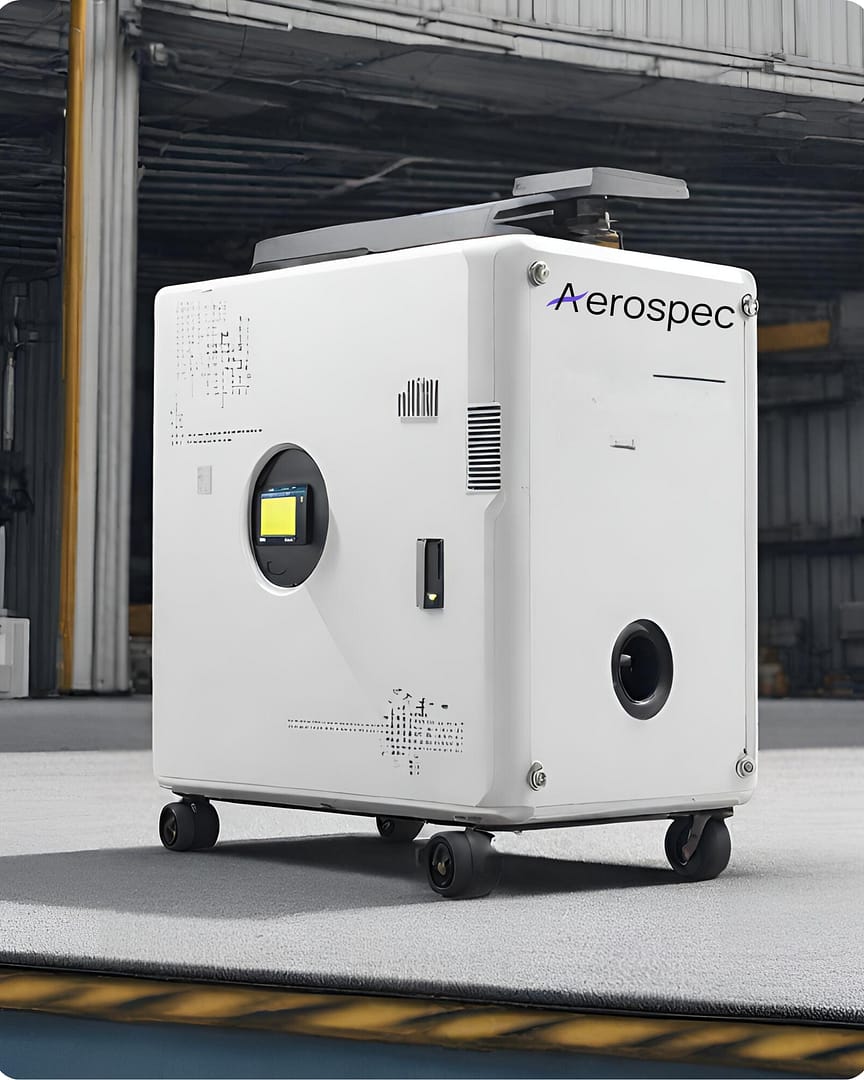
The Aerospec’s AIRMon is a next-generation, real-time aerosol characterization instrument with hardware and software that doesn’t just measure total particulate matter (PM) concentrations, but also reveals the chemical composition and sources of ambient aerosol, or specific chemicals in indoor environments. Moreover, the AIRMon can be enhanced with custom modules for targeted industrial chemicals or workplace health & safety relevant chemicals.
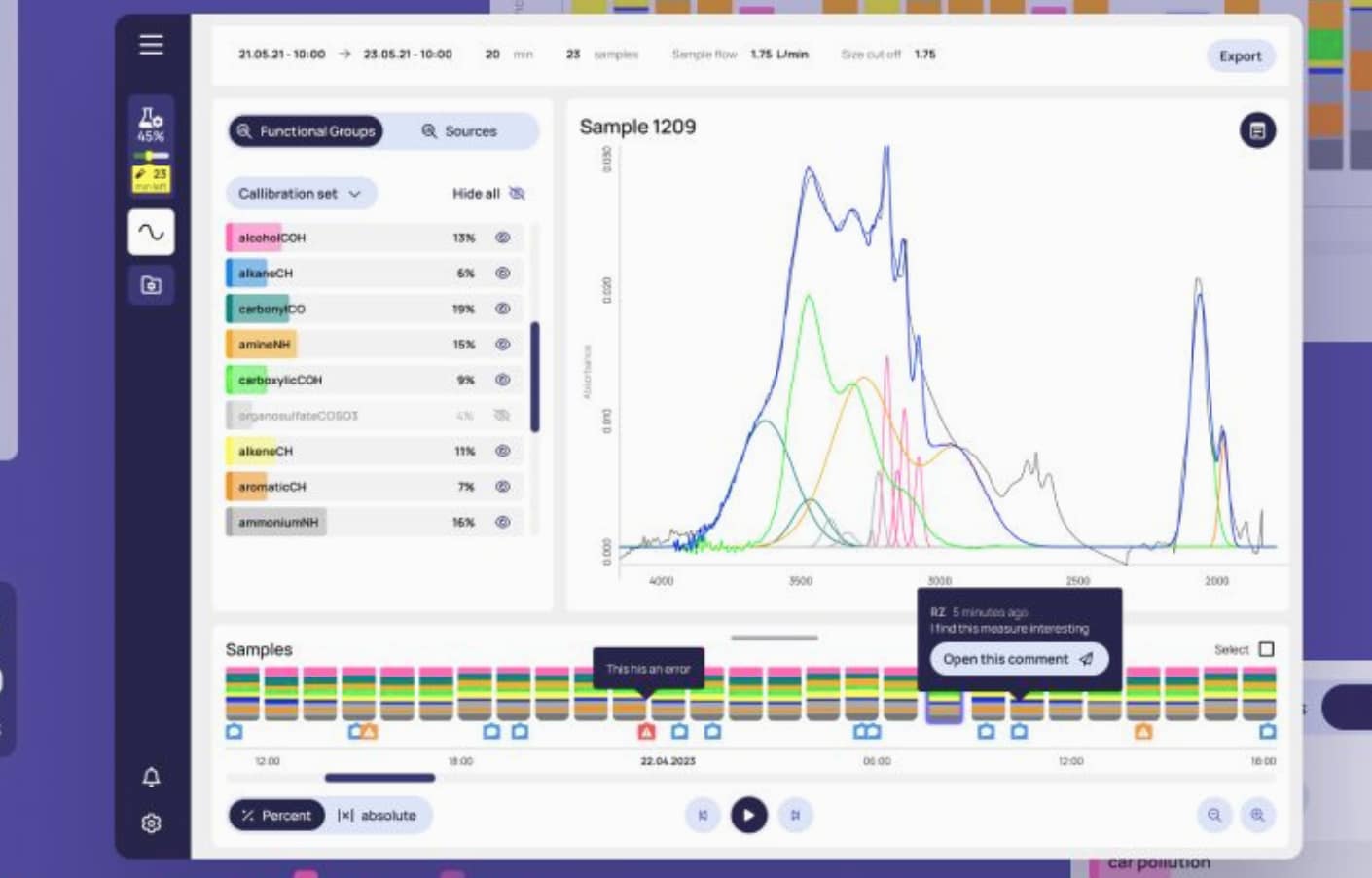
The AIRMon has in-built software with an easy-to-use interface that allows real-time operation, control and analysis. It can be enhanced with custom data outputs or connection to existing data streams, upon request.
A breakthrough in understanding the air we breathe
Every day, billions of microscopic particles move invisibly through the air around us. Some are harmless, but others carry toxic substances that damage our lungs, our hearts, and even our brains. More than seven million people die prematurely each year because of fine particulate pollution yet, despite decades of effort, we still know surprisingly little about what these particles are made of and where they come from.
Aerospec was founded to close that knowledge gap. Our patented Aerosol InfraRed Monitor (AIRMon) is the first fully automated system capable of measuring the chemical composition and sources of particulate matter in near real time. It transforms air monitoring from a slow, manual process into an intelligent, continuous, and actionable stream of insight.

Global death toll of air pollution
According to the latest global assessment, air pollution was responsible for approximately 8.1 million deaths in 2021, making it the world’s second-largest risk factor for death. Our product is designed to change that by delivering actionable data on the chemical composition and sources of particulate matter
Impact on children under five
For children under five, air pollution is now responsible for over 700,000 deaths roughly 15% of all deaths in that age group. This highlights the urgency of deploying technologies that can identify what particles are in the air and where they come from, enabling targeted protective measures for the most vulnerable populations.
Nearly everyone lives with unsafe air
Despite decades of monitoring, nearly 99% of the global population still breathes fine particulate matter at concentrations above the most stringent guideline levels. Conventional instruments often measure only mass our system goes further and reveals chemical composition and source, offering the missing layer of insight needed to act effectively.
Ambient chemical group analysis, revealing the molecular makeup of fine particulate matter.
Source attribution, identifying where emissions originate from traffic, industry, or domestic activity.
Indoor air characterization, supporting occupational-health and process-control applications.
Targeted chemical monitoring, tailored to specific industrial or environmental challenges.
Technology that changes what is possible
AIRMon combines the functions of multiple traditional instruments into one compact, field-ready device. It delivers laboratory-grade precision while drastically reducing cost and complexity. The device is autonomous, portable, and self-cleaning, which makes it ideal for deployment in networks or in remote locations where maintenance access is limited.
Its dual patent protection covers both the novel collector design and the integrated automated analysis system, ensuring Aerospec’s long-term technological leadership. A planned software copyright will further protect the algorithms that enable advanced pattern recognition and source attribution.
With AIRMon, organizations no longer need to choose between accuracy and scale. They can deploy dozens or even hundreds of instruments, building real-time maps of pollution composition and tracing emissions back to their origins.
Accessible models for different needs
Aerospec offers flexible deployment options to meet the diverse needs of our clients. The AIRMon Primary is a ready-to-use, plug-and-play instrument designed for public agencies, environmental networks, and research organizations that require continuous, high-quality air-composition data.
For industrial users who prefer operational flexibility, Aerospec provides leasing and data-as-a-service models. These options allow companies to benefit from the AIRMon system and our advanced cloud analytics platform without significant upfront investment turning complex air-quality analysis into a simple, subscription-based service.
Whether outdoors or indoors, AIRMon delivers precise insight into the air’s chemical composition and its sources. Every deployment becomes a step toward cleaner air, smarter decisions, and a healthier environment. It can be configured for: with AIRMon, every deployment becomes a step toward cleaner air, smarter decisions, and a healthier environment.
Key features
- Continuous composition analysis
AIRMon reveals chemical fingerprints of PM, in form of chemical groups, unlike conventional monitors that only provide aggregate levels or single chemical group. - Source attribution
Differentiates pollution contributions from traffic, industry, biomass burning, combustion, etc. - Fully automated operation
No external instruments required; built-in sample collection, optics, and cloud connectivity. - Compact & field-proof design
Durable, portable, and optimized for deployment in urban, industrial, and remote environments. - Cloud-Based interface & APIs
Access live processed data, visual dashboards, alerts, and exportable reports.
At the heart of AIRMon lies a unique particle collector developed and patented at EPFL. The system automatically gathers fine particulate matter from ambient air, then uses infrared spectroscopy to analyze its molecular composition. Proprietary software interprets the resulting spectra to determine both the chemical makeup and the likely origin of the particles whether they come from traffic, industrial activity, biomass burning, domestic heating, or natural dust.
This process, which once required months of laboratory analysis, now happens every few hours without human intervention. The instrument cleans itself, recalibrates automatically, and transmits data securely to the Aerospec Cloud platform, where it can be visualized, compared, and interpreted. The result is a continuous, detailed picture of what truly makes up the air we breathe.
Where others see numbers, we see meaning each spectrum, each particle, a step toward actionable intelligence. Turning data into decisions that’s our mission!
How It Works
- Sampling & Conditioning
Ambient air is drawn and conditioned for measurement. - Infrared Spectroscopy
Light absorption signatures of aerosol molecules are collected. - Data Processing & Source Allocation
Algorithms attribute sources and compute chemical composition. - Visualization & Alerts
Results are delivered in user dashboards or via API in near real-time. - Three Automated surface regeneration The instrument self-cleans and recalibrates automatically, ensuring continuous and reliable operation without manual intervention.